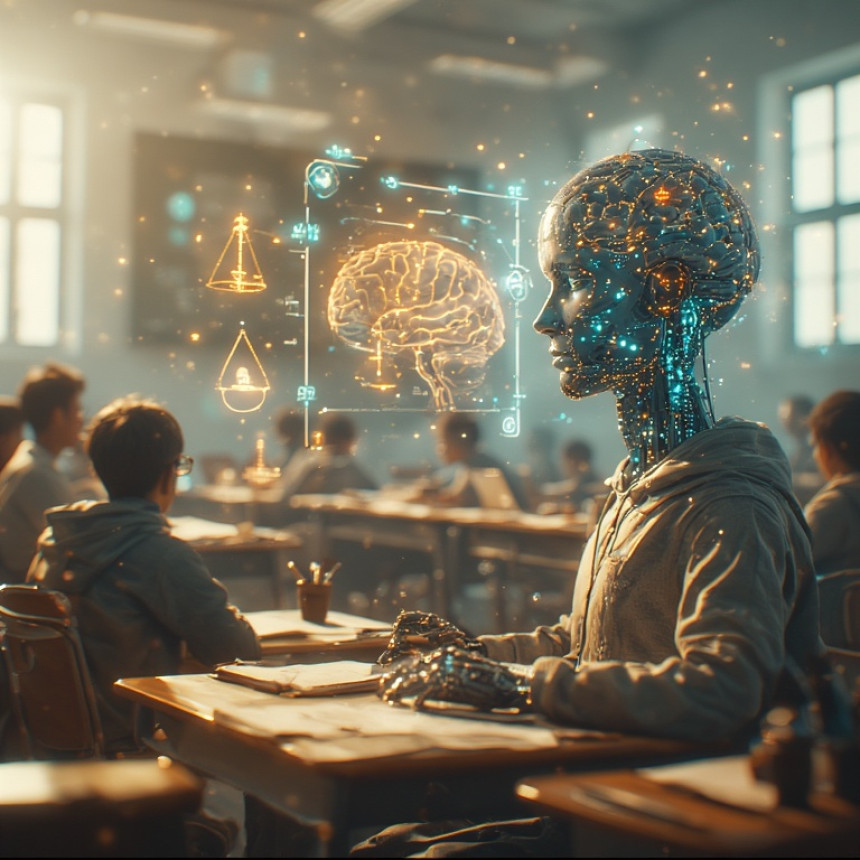

Student Guide to Ethical AI — Skills for the Future
AI is shaping the future, and students must be prepared to use it responsibly. This guide provides essential knowledge on ethical AI practices. Learn how to handle data responsibly, avoid bias, and ensure transparency in your models. With practical examples and structured learning, students can quickly develop real-world skills. Ideal for beginners and professionals, this guide focuses on fast and effective learning. Build AI systems that are not only innovative but also ethical. Prepare yourself for a career where responsibility and technology go hand in hand.
Ethical Considerations in AI for Students — Essentials. Get practical lessons and hands-on examples at AIComputerClasses in Indore to master artificial intelligence (AI) skills quickly. Follow practical exercises and tool-based examples to learn rapidly. This article from AIComputerClasses Indore breaks down ethical considerations in AI for students — essentials into actionable steps. Ideal for beginners and working professionals seeking fast skill gains.
🤖 Ethical Considerations in AI for Students — Essentials
Artificial Intelligence (AI) is revolutionizing every industry — from education and healthcare to business and entertainment. But as AI grows more powerful, ethical considerations become equally important.
For students learning AI at AI Computer Classes – Indore, understanding ethics isn’t just a bonus — it’s essential. In this guide, we’ll explore why AI ethics matter, the key challenges, and how students can build responsible AI systems that positively impact society.
💡 What is AI Ethics?
AI ethics refers to the moral principles and responsible practices that guide the design, development, and use of artificial intelligence technologies.
It ensures that AI systems:
✅ Respect human rights
✅ Are transparent and fair
✅ Protect privacy
✅ Do not cause harm
💬 In simple terms: AI ethics is about doing the right thing — even when machines are doing the work.
🎯 Why Ethics Matter in AI
AI can make decisions faster than humans — but without ethical guidance, it can also make mistakes faster.
Here’s why ethics should be a top priority for every student learning AI:
- Bias and Fairness: AI trained on biased data can produce unfair outcomes.
- Privacy: AI systems often process sensitive personal information.
- Accountability: Who’s responsible when AI makes a wrong decision?
- Transparency: Users should understand how and why AI makes decisions.
- Social Impact: AI can influence jobs, education, and even democracy.
🧠 Ethics ensures that innovation benefits everyone — not just a few.
🧩 Step 1: Recognize Bias in AI Models
AI systems learn from data — and data often reflects human biases.
Example:
If a hiring AI model is trained mostly on resumes from one gender or region, it may unintentionally favor that group.
What students can do:
- Analyze training data for representation
- Use diverse datasets
- Regularly test for biased outputs
💬 Tools like ChatGPT, Python libraries (like Fairlearn), and Power BI dashboards can help visualize bias.
🔐 Step 2: Protect User Privacy
Privacy is one of the most important ethical pillars of AI.
Best Practices for Students:
- Never store personal data without consent
- Use anonymized datasets
- Apply data encryption when training models
- Comply with privacy laws like GDPR
📘 In AI Computer Classes – Indore, students learn data ethics alongside machine learning to ensure real-world readiness.
⚖️ Step 3: Ensure Fairness and Transparency
AI decisions must be explainable. Users should understand why a system made a particular choice.
Techniques for Explainable AI (XAI):
- Use interpretable models (like decision trees)
- Apply SHAP or LIME for model explanation
- Provide clear documentation
💡 If your AI can’t explain its decision — it’s not truly intelligent.
🧠 Step 4: Prevent Misuse of AI
AI can be misused for:
❌ Deepfakes
❌ Automated misinformation
❌ Surveillance without consent
❌ Manipulative marketing
Students must learn to:
- Recognize potential misuse scenarios
- Design systems that include ethical safeguards
- Build AI aligned with human values
🔒 AI education should combine technical skill with moral responsibility.
🧭 Step 5: Accountability in AI
Who is responsible when an AI system fails or harms someone?
The answer should always point to a human — the developer, organization, or user.
Students should:
- Document their code and dataset sources
- Be transparent about model limitations
- Promote human oversight in AI deployment
🧩 AI should support human decision-making, not replace it.
🌍 Step 6: Understand AI’s Impact on Society
AI can shape job markets, education, and social structures. Students learning AI should ask:
- Will this system create or replace jobs?
- Does it make education more accessible or more exclusive?
- Could it reinforce stereotypes or inequality?
📊 At AI Computer Classes – Indore, students explore real-life case studies — from ChatGPT in classrooms to AI in healthcare — to discuss both benefits and challenges.
🧪 Step 7: Follow Responsible AI Frameworks
Several global organizations have defined frameworks for ethical AI. Here are some you should know:
FrameworkKey PrincipleUNESCO AI EthicsHuman-centered AIGoogle AI PrinciplesFairness, safety, accountabilityMicrosoft Responsible AIInclusiveness, transparencyOECD GuidelinesSustainable AI innovation
✨ Use these as ethical checklists when working on your projects.
🛠️ Step 8: Practical Classroom Exercises
Here’s how students at AI Computer Classes – Indore can practice AI ethics hands-on:
ExerciseObjectiveAudit an AI dataset for biasIdentify underrepresented groupsBuild a simple explainable modelUse Python and LIMEWrite an AI Ethics ReportReflect on fairness and impactGroup DiscussionDebate AI regulation and privacy issues
💬 Learning ethics is not about memorizing rules — it’s about developing moral awareness through projects.
🧰 Tools for Ethical AI Development
Students can explore these tools to make their AI projects more transparent and fair:
ToolPurposeIBM AI Fairness 360Detect and reduce biasGoogle What-If ToolVisualize model decisionsTensorFlow PrivacyApply differential privacyFairlearn (Python)Analyze and mitigate fairness issues
💻 Combine these with ChatGPT to discuss, test, and improve ethical reasoning in AI projects.
🎓 Learn Ethical AI at AI Computer Classes – Indore
At AI Computer Classes – Indore, our Artificial Intelligence (AI) course emphasizes:
- Responsible data handling
- Bias detection in machine learning models
- AI explainability and transparency
- Real-world ethics through interactive projects
🧑💻 Whether you’re a student or a professional, learning ethical AI ensures your work contributes positively to society.
🏁 Conclusion
Ethics is the soul of artificial intelligence. Without it, even the smartest systems can cause harm. As a student, developing ethical awareness early helps you become not just a great AI engineer — but a responsible innovator.
💬 In the AI-driven future, ethical intelligence will be as valuable as technical intelligence.
📞 Contact AI Computer Classes – Indore
✉ Email: hello@aicomputerclasses.com
📱 Phone: +91 91113 33255
📍 Address: 208, Captain CS Naidu Building, near Greater Kailash Road, opposite School of Excellence For Eye, Opposite Grotto Arcade, Old Palasia, Indore, Madhya Pradesh 452018
🌐 Website: www.aicomputerclasses.com